Capability != Interpretability: Human Interpretability of Vision Foundation Models
Capability != Interpretability: Human Interpretability of Vision Foundation Models
This page is the main landing page for the paper often searched as “human interpretability of foundation models” or “human interpretability of vision foundation models.”
| Paper PDF | arXiv |
Authors
Julien Colin, Lore Goetschalckx, Nuria Oliver, and Thomas Serre
Abstract
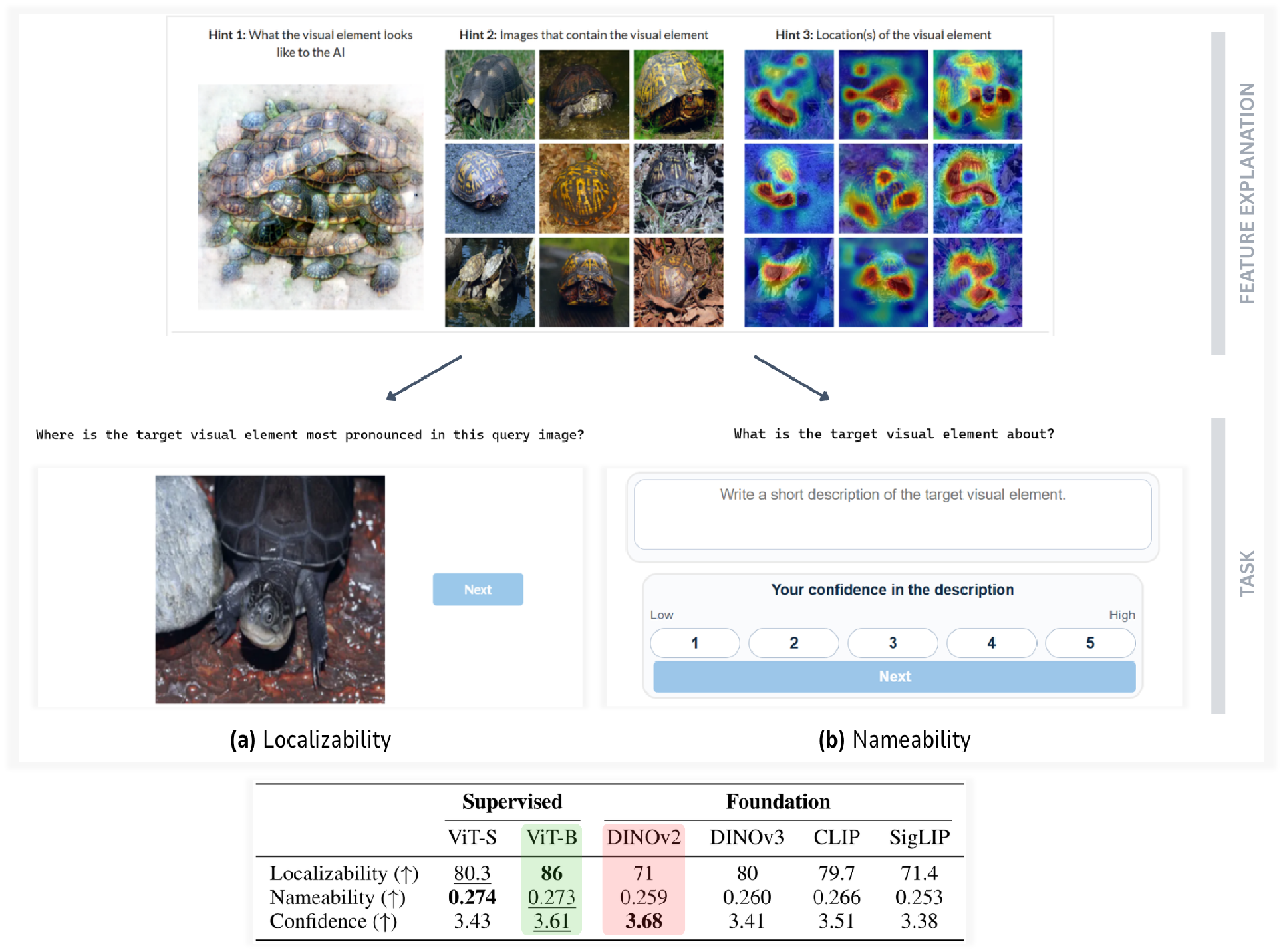
Which modern vision models learn the most interpretable features? We introduce a human-centric framework for measuring and comparing interpretability through two psychophysics protocols: localizability, which asks whether people can predict where a feature fires, and nameability, which asks whether people can describe what it represents.
Applying this framework to roughly 6,000 sparse autoencoder features from six vision transformers, we collect more than 15,000 quality-filtered responses from about 440 participants. We find that foundation models such as DINOv2, DINOv3, CLIP, and SigLIP are consistently less interpretable than supervised counterparts.
Crucially, this is not a capability tradeoff: interpretability is uncorrelated with downstream task performance. Instead, interpretability is better predicted by the locality of the representation and its coarse semantic alignment with humans, which suggests that interpretability is its own measurable dimension of representation quality.
Citation
@unpublished{colin2026foundations,
  title={Capability != Interpretability: Human Interpretability of Vision Foundation Models},
  author={Colin, Julien and Goetschalckx, Lore and Oliver, Nuria and Serre, Thomas},
  year={2026},
  journal={arXiv preprint},
  arxiv={2605.20337}
}